You have led teams. You have shipped products real customers depend on. You have probably hired people yourself.
Then the interviewer smiles and says, “So, tell me about yourself.” And you start at the beginning of your career.
Four minutes later, you are still in 2012.
This is how experienced people lose the room. Not a lack of experience. Too much of it, and no clear way to choose. Answering to tell me about yourself as a senior professional is a different job from answering it at 25, and most senior candidates were never shown the difference.
The Short Answer
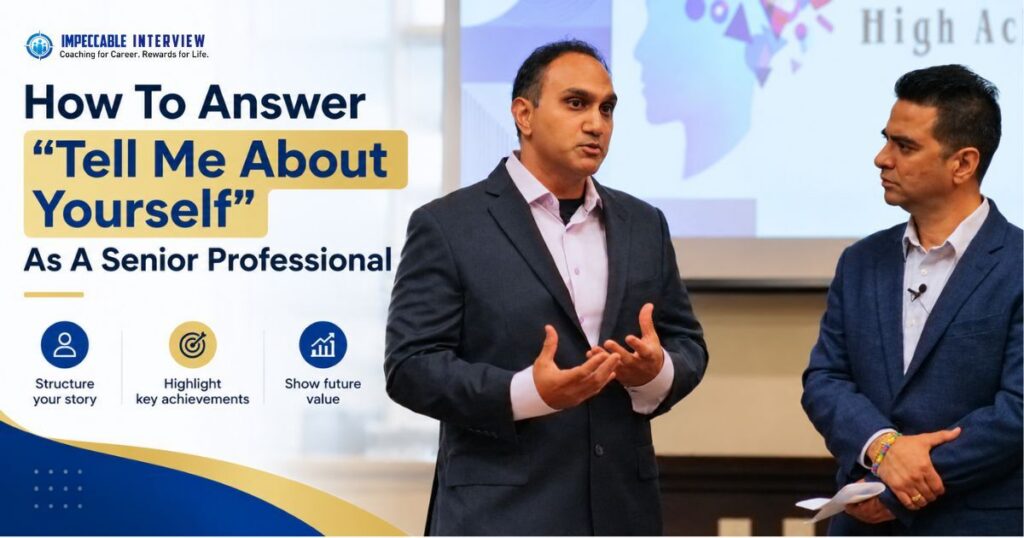
To answer, tell me about yourself as a senior professional, open with who you are at the level you operate today, back it up with one or two outcomes that match the problems this role exists to solve, and close with why this move makes sense now. Keep it to roughly 60 to 90 seconds. Skip the career tour. The interviewer needs the right thing, told at the right altitude.
Why This Question Gets Harder the More Senior You Are
For a junior candidate, “tell me about yourself” is a warm-up. For a director or senior manager, it’s the first real test.
Senior roles are about judgment. Knowing what matters and cutting what doesn’t. Walk through every role since college, and the interviewer is previewing how you’ll brief executives.
There’s a second problem. Many senior professionals haven’t interviewed externally in years. Inside one company, their reputation did the talking. Then a layoff or reorganization changes that overnight, and suddenly they’re competing with strangers.
They are qualified. They just don’t sound ready yet. That’s the gap.
What the Interviewer Is Actually Listening For
Hiring managers rarely say it out loud, but your interview introduction is being scored against a few quiet questions:
- Altitude. Do you describe your work in business outcomes and decisions, or in tasks and tools?
- Editing. Can you choose? A focused answer signals the prioritization a senior role demands.
- Self-awareness. Can you name what you’re known for in one sentence?
- Conviction. Do you sound like you believe your own story?
A study of more than 600 thirty-minute interviews, reported by Quartz, found about a quarter of interviewers reached a decision within five minutes, and roughly 60% within fifteen. Those were student and graduate candidates, so treat the numbers as directional. The point still holds. Your opening answer sits right inside the window where impressions form.
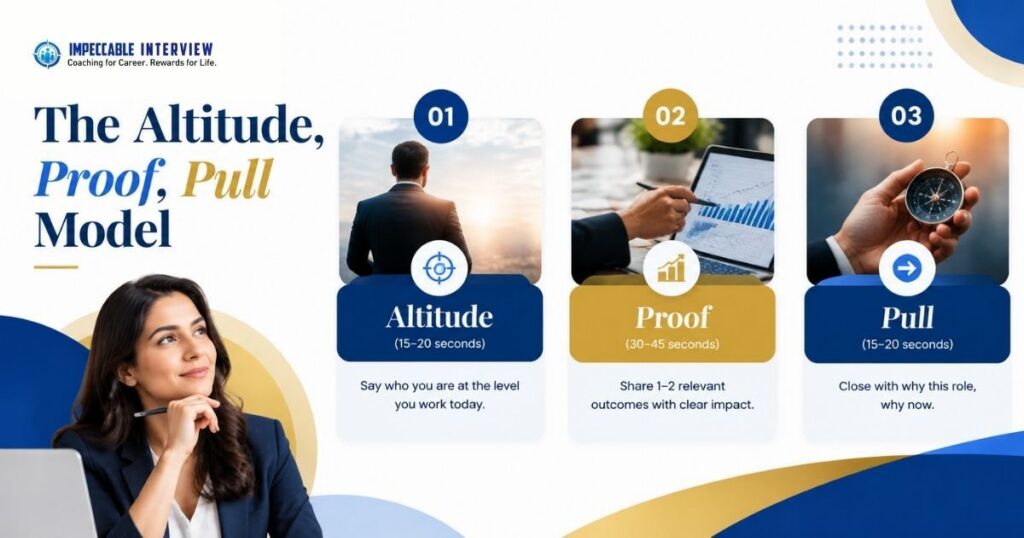
The Altitude, Proof, Pull Model
Most advice online gives you “present, past, future.” That tells you the order, not what to say.
We use a simpler test in coaching sessions. Every strong senior introduction does three things.
1. Altitude (about 15 to 20 seconds)
Say who you are at the level you work today. Not your title history. Your professional identity: what you do, at what scale, and what people come to you for.
“I’m an engineering leader who builds platform teams other teams can rely on.” That’s altitude. “I’ve been in software for 18 years” is just a number. It tells the interviewer nothing about how you think.
2. Proof (about 30 to 45 seconds)
Pick one or two outcomes that match this role’s problems. Not your favorite projects. Their problems. If the job description talks about scaling through hypergrowth, your proof should be about scaling. Use numbers only if you can defend them in a follow-up, because a good interviewer will ask.
And make your role clear. Credit the team, then name your decisions.
3. Pull (about 15 to 20 seconds)
Close with why this role, why now. Then leave a thread the interviewer wants to pull. This explains your motive and steers the next question toward the ground you’ve chosen.
Altitude, proof, pull. If one is missing, the interviewer feels it even if they can’t name it.
How to Answer Tell Me About Yourself as a Senior Professional: Three Examples
These examples are illustrative. Use your own facts.
Example 1: The career tour vs. the leadership answer
Weak version (Director of Engineering):
“Sure. I started as a Java developer at a telecom company back in 2008. After four years I moved to an e-commerce startup as a senior engineer, then became a team lead. In 2017 I joined my current company as an engineering manager and was promoted to director in 2021. Now I manage about 40 engineers.”
Nothing here is wrong. It’s just a résumé read aloud.
Stronger version:
“I’m an engineering leader who builds platform teams the rest of the company can depend on. Right now I run about 40 engineers responsible for our payments infrastructure. Over the last 18 months, we went from a fragile monthly release process to shipping weekly, and customer-facing incidents dropped sharply. What draws me here is that your platform has to scale ahead of the product. That’s the problem I most want to work on next.”
Same person. Same career. The second answer sounds like someone already doing the job.
Example 2: Nervous framing vs. conviction framing after a layoff
Nervous version (Senior Product Manager):
“So, I was part of the layoffs earlier this year, which honestly came as a surprise. I’m pretty open to anything in the product right now.”
This answer leads with loss and ends with “anything.” The interviewer hears uncertainty before they hear value.
Conviction version:
“I’m a product leader who does my best work in the messy middle, between a product that works and a business that scales. Most recently I led growth for our core analytics product, where my team rebuilt onboarding and turned a leaky trial into our strongest acquisition channel. That role was eliminated in a reorganization this spring. Your team stood out because you’re moving upmarket without losing self-serve customers, and that’s exactly the tension I’ve spent three years managing.”
The layoff gets one sentence. No apology. Then the answer moves forward.
Example 3: The AI-polished answer vs. the human one
AI-polished version: “I am a results-driven technology leader with over 15 years of experience driving innovation and delivering scalable solutions across diverse, cross-functional teams.”
Human version: “For most of my career, I’ve been the person who gets called when a product works in the demo and breaks in production.”
The first sounds impressive for three seconds, then sounds like everyone else. The second sounds like a person, because it is one.
Adjusting Your Interview Introduction for Each Round
Strong senior interview answers aren’t one script. They’re one story, told at the right altitude for the person listening.
- Recruiter screen. Shorter. Make your level, focus, and target role unmistakable.
- Hiring manager. Point your proof at their team’s problems.
- Panel interview. Keep it tight. Add one line showing you work well with the functions in the room.
- Technical leadership round. Name one real technical decision and the trade-off behind it.
- Executive or CEO round. Go higher. Good executive interview answers connect your work to revenue, risk, speed, or customer trust.
Mistakes That Quietly Cost Senior Candidates the Room
These rarely show up in feedback. Candidates just don’t hear back.
- Starting at the beginning. Chronology feels safe. It also buries your best material in minute three.
- Title-heavy, outcome-light. Titles describe where you sat. Outcomes describe what changed because you were there.
- Talking past two minutes. That’s a monologue, not a conversation.
- Apologizing. For a layoff, a gap, or a long tenure. State the fact once and move on.
- Reciting a memorized script. It cracks the moment a senior interviewer interrupts.
The Real Problem Is Rarely the Answer
When a senior professional struggles with this question, the answer is usually just the symptom. The interview is the presenting problem. The deeper issue tends to be confidence, positioning, storytelling, AI-era readiness, or an outdated view of what’s possible next.
We see it constantly. Someone arrives worried, sometimes angry, after months of first-round interviews that go nowhere. Their introduction sounds flat because, underneath, they’re no longer sure what they stand for.
You can’t fix that with a better template. You fix it by getting clear on your real value, then practicing until you believe it. Belief is audible. So is doubt.
That’s the work behind Elite Interview Coaching. Impeccable Interview brings CEO-grade coaching tools, technology leadership experience, hiring-manager insight, and high-stakes interview preparation to help clients build clarity, confidence, and conviction. We don’t just help professionals find better answers. We help expand the range of answers they believe are available to them.
Shorten the learning curve. Avoid months of trial and error. You can see how that shift played out for others in our success stories.
AI Can Help You Prepare. It Can't Walk Into the Room for You.
AI has raised the bar. The World Economic Forum’s Future of Jobs Report 2025 found employers expect 39% of workers’ core skills to change by 2030, with AI and big data ranked as the fastest-growing skill area. Candidates who aren’t up to speed on AI can struggle to look future-ready, even with strong experience.
You don’t need to pretend to be an AI expert. But one honest line about how AI is changing your work lands well. Something like, “This year I reworked how my team uses AI in code review, and it changed how I think about team structure.” Only say it if it’s true.
Use AI to rehearse, not to write the final version. AI can make your answers sound polished and empty. A real interview isn’t a script. It’s a human conversation.
A Note for Bay Area Technology Leaders
In Silicon Valley, multi-round loops mean you’ll introduce yourself four or five times in a single day, to people with very different agendas. Each listener needs a different emphasis. A memorized script can’t adapt.
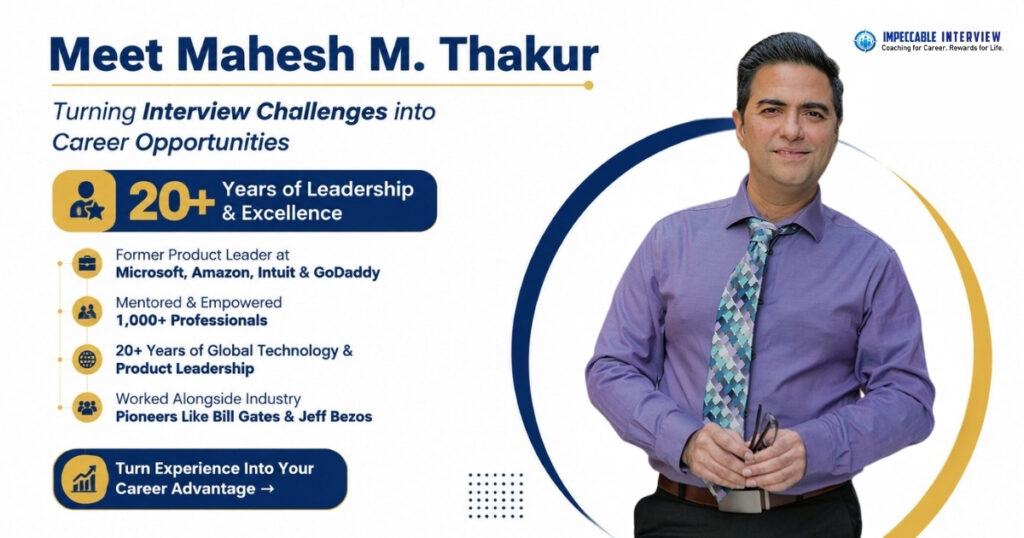
Many Bay Area candidates are also returning after long stretches at one large company. The task is translating your experience for people who’ve never worked with you. Mahesh has spent his career in technology leadership and on the hiring side of the table. Read more about Mahesh and how he works with clients.
Say Less. Mean More.
The goal isn’t to tell everything. The goal is to tell the right thing.
When you answer, tell me about yourself as a senior professional, you’re not summarizing your career. You’re showing how you think, what you prioritize, and why you’re the person for this problem. Get the altitude right, choose your proof, and give them a reason to lean in.
Ready to Sharpen Your Story?
If you are preparing for a high-stakes interview, Impeccable Interview can help you sharpen your story, practice difficult questions, and show up with clarity when it matters most.
FAQs
Aim for 60 to 90 seconds, and never more than two minutes. That’s long enough to show altitude, one or two strong outcomes, and your reason for the move. Anything longer turns an opening into a monologue. If the interviewer wants more, they’ll ask.
Mention it only if it explains your timeline or the interviewer will reasonably wonder about it. Keep it to one neutral sentence, such as “My role was eliminated in a reorganization this spring.” Then move straight to what you’re looking for next. Don’t apologize or over-explain.
The difference is altitude. Mid-level answers usually describe tasks, projects, and tools. Executive interview answers describe business outcomes, judgment calls, trade-offs, and the leaders you’ve built. The interviewer wants evidence that you think about the whole business, beyond your own function.
No. Memorize your first sentence and your structure, then practice the rest out loud until it flows naturally. A word-for-word script breaks when you’re interrupted and sounds rehearsed even when it isn’t. Strong senior interview answers sound prepared, not recited.
Use AI as a sparring partner, not a ghostwriter. It’s useful for tightening a draft, testing your answer against a job description, or playing a tough interviewer. The final version should be in your own words, with your own specific examples. Generic AI phrasing is easy to spot and makes experienced candidates sound interchangeable.