You’ve read the About page. You’ve skimmed the latest press release. You can recite the mission statement word for word. And still, when the hiring manager asks, “Why us?”, the answer comes out sounding like everyone else’s.
This is one of the quietest mistakes we see at Impeccable Interview. Candidates do the reading, but they don’t do the research. They collect facts about a company instead of building a point of view about it. The interviewer can tell the difference within about thirty seconds.
A strong company research strategy isn’t about knowing more than the other candidates. It’s about knowing what matters and showing it at the right moment.
What Company Research Before an Interview Actually Means
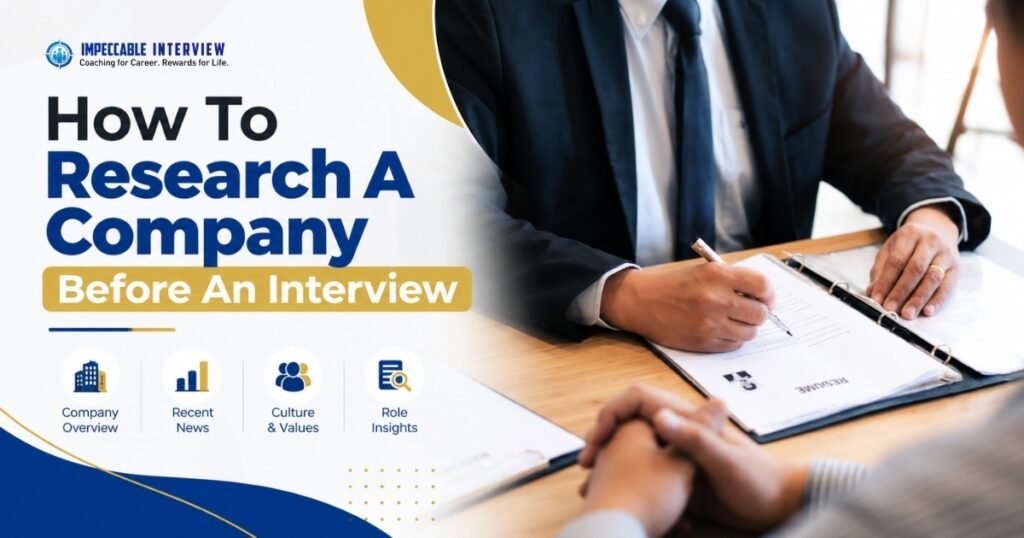
Proper company research interview preparation means understanding four things before you walk in: what the business is trying to win, what’s getting in its way, how the team you’re joining fits into that picture, and where your experience solves a real problem for them. Good employer research turns public information into specific talking points, sharper answers and better questions. It shouldn’t produce a page of trivia you’ll never use.
Why Experienced Candidates Get Employer Research Wrong
Senior professionals often assume research matters less at their level. They’ve been in the industry for years. They know the competitors, the market and half the people in the room. Why spend a weekend reading annual reports?
Because the interviewer isn’t testing what you know about the industry. They’re testing what you know about this company, right now. A director candidate who talks about the market in general terms sounds like a consultant pitching from the outside. One who connects their experience to a specific challenge the company named in its last earnings call sounds like someone who already works there.
Experience gives you context. Research gives you relevance. You need both.
The Surface Problem: Too Many Facts, Too Little Insight
Most candidates stop at the surface. They know when the company was founded, roughly how many people work there and which product launched last quarter. None of that helps them in the room.
The issue isn’t effort. It’s filtering. A public company produces hundreds of pages of information every year. A fast-growing startup puts out blog posts, podcasts and hiring updates almost weekly. Without a way to sort signal from noise, candidates either memorise everything or nothing, and neither works.
What interviewers remember is the candidate who picked up on one real tension in the business and spoke to it directly.
The Company Signal Mapping Model
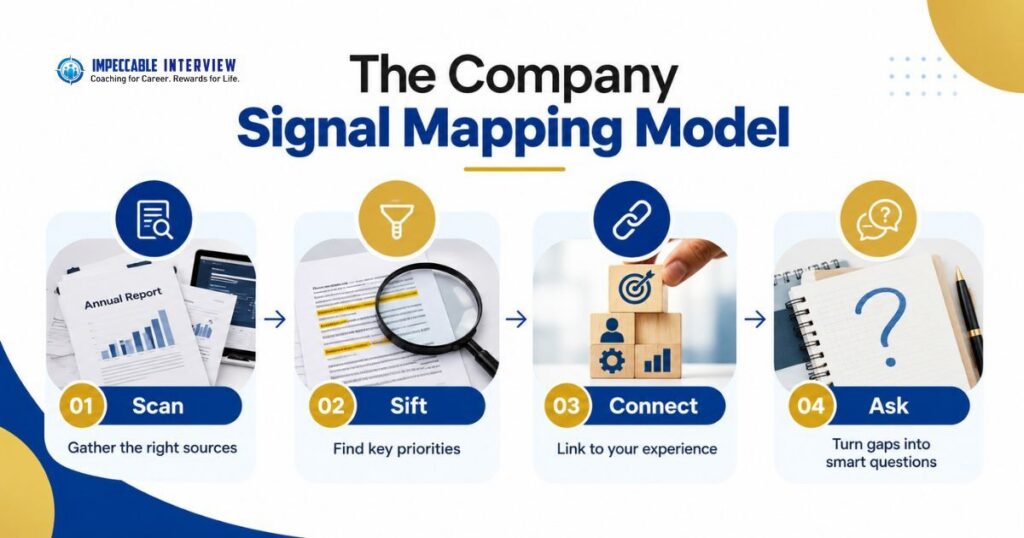
This is the model we use with clients who need their research to show up in their answers, not just in their notes. It has four stages.
Scan: Gather the sources that reveal priorities, not just publicity. For public companies, that means the latest annual report (10-K), recent earnings call transcripts and investor presentations. For private companies, look at funding announcements, leadership interviews, engineering or product blogs and the job descriptions they’re currently posting.
Sift: Look for repeated themes. If leadership mentions “efficiency” in three different places, or the company is hiring heavily for one function, that’s a signal. Write down no more than three priorities you’re confident about. Anything beyond that is detail you won’t use.
Connect: Match each priority to a story from your own career. If the company is moving upmarket to enterprise customers and you’ve led that shift before, that’s your strongest card. Don’t wait for the interviewer to make the link. Make it for them.
Ask: Turn whatever you couldn’t confirm into sharp questions. Public sources rarely show internal trade-offs, so the best interview questions sound like this: “I noticed the shift towards platform revenue in your last two quarterly updates. How is that changing priorities for this team?”
Four stages. Three priorities. One clear link between their problems and your experience.
Weak Answer vs. Researched Answer
Interview question: “Why do you want to work here?”
Weak answer: “I’ve always admired the company’s innovation and culture. You’re a leader in the space, and I really connect with your mission of empowering customers. I think my skills would be a great fit for the team.”
It’s polite and positive, and every other candidate on the schedule could have said it. There’s nothing specific in it, nothing that proves you looked, and nothing the interviewer can repeat in the debrief.
Researched answer: “Your last two earnings calls focused heavily on reducing churn in the mid-market segment. That’s exactly the problem I spent three years on at my last company. We cut churn by restructuring onboarding around the first ninety days. I’d like to understand how this role connects to that goal, because it’s the kind of problem I do my best work on.”
The candidate and the experience level are the same in both. The first sounds hopeful. The second sounds like someone who’s already thinking about the job.
Another Example: Researching the Team, Not Just the Company
Interview question: “What do you know about our team?”
Weak answer: “I know you’re part of the product organisation and you work on the core platform.”
Researched answer: “I read your VP’s post about moving from quarterly planning to six-week cycles. I’ve run both models, and the move usually exposes gaps in how teams handle dependencies. I’d be curious how that transition is going.”
Specific research earns you a real conversation. Generic research gets you a polite nod.
Where to Look: Sources That Reveal Real Priorities
Not every source is equal. For company research interview preparation, these tend to give the clearest picture:
- Annual reports and 10-K filings: strategy, risks and segment performance, in the company’s own words.
- Earnings call transcripts: what leadership is promising investors this quarter, and which questions analysts keep asking.
- Engineering and product blogs: how teams actually work and what they’re building next.
- Job postings across the company: where headcount is growing, which often points to the next big bet.
- Employee review sites such as Glassdoor: useful for spotting patterns, though individual reviews can be skewed.
- Leadership podcasts and conference talks: unscripted views you won’t find in a press release.
Private companies publish less, so lean on funding news, customer case studies and founder interviews instead. Thorough employer research isn’t about using every source. It’s about using the two or three that answer your questions fastest.
What Professional Job Interview Preparation Looks Like in Practice
Good Job Interview Preparation isn’t a one-hour cram session the night before. It’s a structured process that links three things: what the company needs, what you’ve done, and how you’ll say it under pressure.
In practice, that means:
- Building a one-page company brief with three priorities, two risks and one open question
- Mapping your top five stories to the priorities you found
- Rehearsing your “Why us?” answer until it takes under ninety seconds
- Preparing three tailored questions for each interviewer, based on their role
- Pressure-testing your answers with someone who will push back
That last step is where interview preparation Coaching makes the biggest difference. Done well, Job Interview Preparation turns your research into a quiet advantage that runs through every answer. A coach can tell you when your research sounds borrowed or when your link to the company’s priorities is too weak to hold up. That’s hard to judge on your own.
AI Can Speed Up Your Research. It Can Also Make You Sound Like Everyone Else.
Plenty of candidates now ask AI tools to summarise a company before an interview. That’s a reasonable shortcut for getting oriented. The problem starts when the summary becomes the answer.
An AI-generated line usually sounds like this: “The company is a leading provider of innovative solutions committed to driving customer value through digital transformation.” It’s clean and confident, and it means nothing. The interviewer has heard it from a dozen other people this month.
Here’s what a human-researched version sounds like: “Your CTO mentioned on a podcast in the spring that most of the team’s technical debt sits in billing. I’ve rebuilt a billing system twice, so that comment stood out to me.”
AI is good at summarising what’s public. It’s poor at spotting what’s interesting. Use it to save time on the first scan, then do the thinking yourself.
The Impeccable Interview Point of View
Most candidates who come to us aren’t short on information. They’re short on judgement about which pieces of it to use.
We don’t treat employer research as a homework exercise. We treat it as the raw material for every answer you give. When your research is done properly, it shows up everywhere: in your opening pitch, in the way you frame your stories, and in the questions you ask at the end. Interviewers rarely say, “This candidate researched us well.” They say, “This person gets what we’re trying to do.” That’s the outcome we coach towards, and it’s why our interview preparation Coaching starts with research, not rehearsal.
Why This Matters More in Bay Area Interview Loops
Bay Area hiring loops for senior roles move quickly and often involve several interviewers in a single day. You might meet an engineering director in the morning, a product leader after lunch and a cross-functional panel to finish. Each one will look at the company through a different lens.
Your company research interview preparation needs to flex across all of them. The engineering director cares about technical debt and team velocity. The product leader cares about customers and market position. The panel wants to know you understand how the pieces fit together. Candidates who tailor their research to each conversation tend to stand out in the debrief. Candidates who repeat the same company summary five times usually don’t.
Silicon Valley companies also shift direction fast. A strategy announced six months ago may already have changed. Check the most recent sources in the week of your interview, not the month before.
How to Start Researching on Your Own
Not ready for coaching yet? These steps will strengthen your company research interview preparation on your own:
- Start with the money. Read the latest earnings call or funding announcement first. It tells you what leadership is under pressure to deliver.
- Read the job description twice. The second time, underline every problem it hints at. Those are your talking points.
- Look up your interviewers. Check their LinkedIn activity, talks and published posts. Find one thing you can genuinely ask them about.
- Limit yourself to three priorities. If you can’t explain them in a minute, you haven’t finished sifting.
- Say your “Why us?” answer out loud. If it could apply to any company, rewrite it.
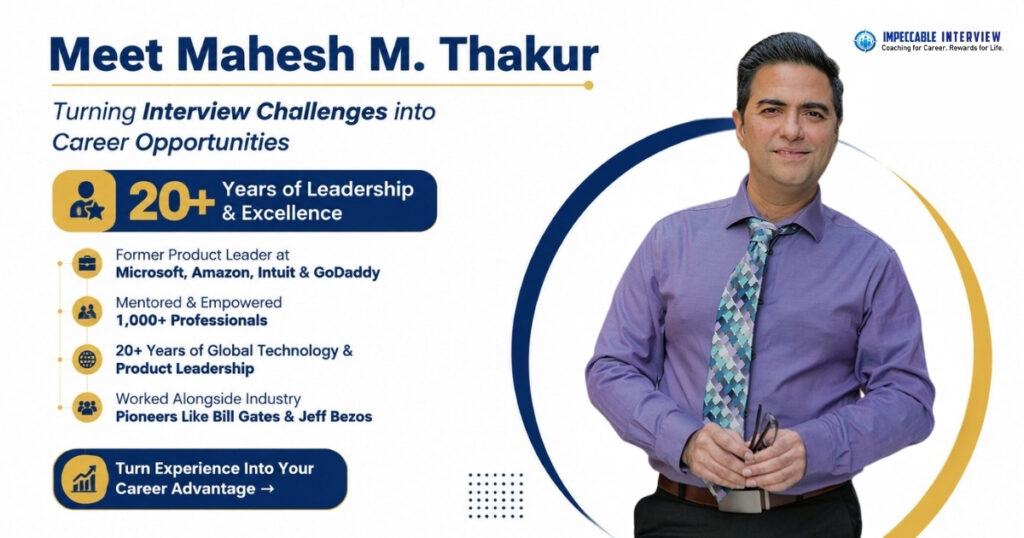
You can see how this plays out for real candidates on our Success Stories page, explore our Elite Interview Coaching approach, or learn more on the About Mahesh page.
Frequently Asked Questions
For most senior roles, plan for three to five focused hours. Spend that time on recent earnings calls, leadership interviews and the job description. Effective company research interview preparation depends more on filtering for relevance than on total reading time.
Focus on business priorities, recent financial results, leadership’s public statements, the team’s goals and current challenges. Good employer research also covers your interviewers’ backgrounds, so you can tailor your answers and questions to exactly what each person cares about most.
Weave it into your answers rather than reciting facts. Link one company priority to a relevant story from your own experience, then ask a specific follow-up question. That approach shows genuine understanding and gives interviewers something memorable to discuss afterwards.
Yes. Interview preparation Coaching helps you decide which findings matter, connect them to your strongest stories and test whether your answers sound specific enough. A coach spots generic research quickly, before an interviewer does, and helps you sharpen it further.
Rarely, on its own. Company websites show polished messaging, not real priorities. Strong Job Interview Preparation draws on earnings calls, annual reports, leadership interviews, engineering blogs and job postings, which reveal what the business is actually focused on right now.
Ready to Communicate With More Clarity and Conviction?
If you are preparing for a high-stakes interview, Impeccable Interview can help you sharpen your story, practice difficult questions, and show up with clarity when it matters most.