She’d cleared four rounds. Recruiter screen, hiring manager, a panel of three, a skip-level with the VP. Strong feedback every time, according to the recruiter. Then the offer went to someone else.
When we finally talked it through, the problem wasn’t any single answer. It was that she’d walked into each round as its own event – no thread connecting them, no sense of what the whole day was supposed to add up to. That’s not a storytelling gap. That’s a missing senior interview strategy.
What a Senior Interview Strategy Actually Requires
A senior interview strategy is a plan for the entire loop, not just the next question. It sets the two or three things every interviewer needs to walk away believing, and it makes sure those points survive contact with five different people asking five different versions of the same question.
Why Most Senior Candidates Walk In Without Strategy
Junior candidates usually over-prepare individual answers and under-prepare everything else. Senior candidates flip that. They’ve done this work for years, so the instinct is to trust the material and wing the structure.
That works fine for a single 45-minute conversation. It falls apart across a full day of interviewers comparing notes afterward – because nobody in the room heard the same version of who you are.
The One-Round Mindset Problem
Most candidates prepare for “an interview,” singular. Senior loops rarely work that way. A director-level search might run five or six distinct conversations, each testing a different angle: technical depth, people leadership, executive presence, cross-functional influence.
Without a job interview strategy tying those conversations together, candidates end up repeating the same one or two stories, contradicting their own framing round to round, or burying the message an interviewer actually needed to hear under one they thought sounded more impressive.
The MAP Advantage Framework
This is the framework we use with clients who have plenty of experience and no coherent plan for presenting it. Four stages, built specifically for senior interview preparation across a full loop rather than a single conversation.
- Map: Chart every likely interviewer and what each one is actually screening for. A skip-level VP and a peer engineering lead are not listening for the same thing, even when they ask an identical question.
- Anchor: Fix the two or three core messages that must land regardless of who’s asking or what they ask. Everything else in the loop supports these – nothing competes with them.
- Position: Adjust delivery, not substance, for each audience. The technical detail a peer wants is the noise a VP tunes out; the same story needs a different entry point for each.
- Pressure-test: Run the whole sequence out loud, back-to-back, with someone interrupting and switching angles mid-story. A plan that only survives in isolation isn’t a strategy yet.
Weak Strategy vs. Coached Strategy
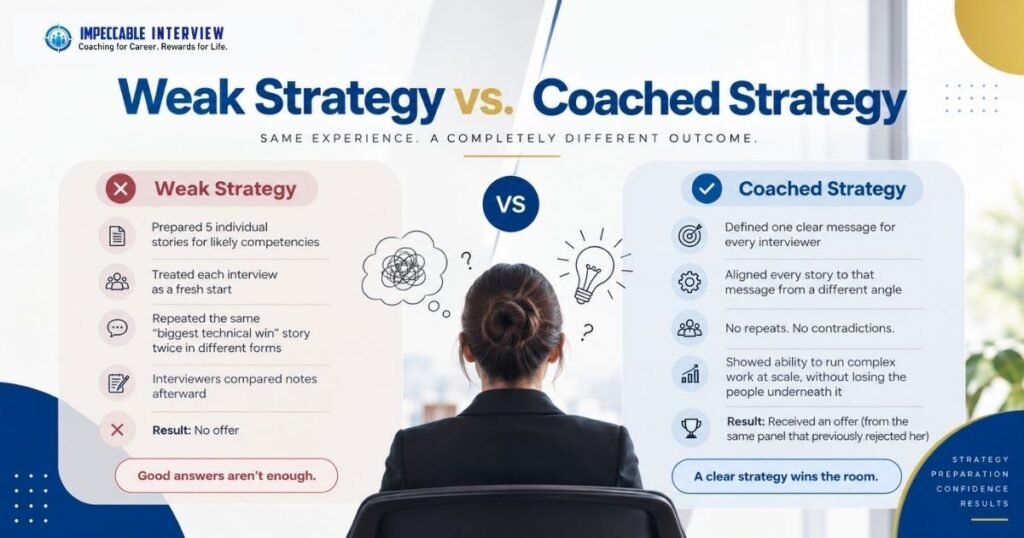
Take a real case: a senior engineering manager interviewing for a director role across five rounds in one week.
Weak approach: She prepared five strong individual stories, one per likely competency, and treated each interview as a fresh start. By round four, she’d told the same “biggest technical win” story twice, in two different forms, to two interviewers who compared notes afterward.
Coached approach: Before round one, she named the single message she needed every interviewer to leave with – that she could run technically complex work at scale without losing the people underneath it. Every story she told, across all five rounds, fed that one line from a different angle. No repeats. No contradictions. The offer came from the same panel that rejected her the previous cycle, for the role one level up.
Same person. Same experience. One had an interview strategy; the other had five good answers hoping to add up to something.
What Real Senior Interview Preparation Looks Like in Practice
Good senior interview preparation isn’t a single mock interview the week before. It’s mapping the likely panel, deciding what each round needs to prove, and rehearsing the full sequence – not just individual answers – until the throughline holds under pressure.
A coach worth hiring will ask what you want interviewer three to believe that interviewer one already does, and push back if you can’t answer that cleanly.
AI Can Help You Prep. It Can't Build Your Strategy.
AI tools are genuinely useful for drafting a first pass at individual answers or tightening a resume bullet. What they can’t do is sit across five interviewers and decide which message needs to land with which one, in which order, using which story.
Strategy requires judgment about people in a room who haven’t met you yet. That’s a coaching problem, not a prompting problem.
The Impeccable Interview Point of View
Most senior professionals who come to us already interview well, round by round. What they haven’t done is step back and ask what the whole loop is supposed to accomplish, and whether their five separate performances actually build a single, coherent case.
That’s the real value of working through a deliberate senior interview strategy before the loop starts, not after round three goes sideways.
Why This Matters More for Bay Area Senior Loops
Bay Area hiring loops for senior and staff-plus roles have only gotten longer. Recent industry benchmarking shows the average number of interview rounds per hire rose sharply between 2021 and 2024, with technical roles climbing fastest, and multi-stage loops of five or more rounds are now common rather than exceptional.
More rounds mean more chances for a message to blur or contradict itself. A candidate with a tight, deliberate job interview strategy holds together across that length. A candidate without one tends to get diluted, even when every individual round went fine.
How to Start Building Your Own Interview Strategy
- Write down the one sentence every interviewer needs to believe by the end of the loop, before you write a single story.
- List every likely interviewer and what each one is actually there to test.
- Match no more than two stories to each person – resist the urge to tell your best story to everyone.
- Rehearse the full sequence back-to-back, not each round in isolation, and time it.
You can see how this plays out for real candidates on the Success Stories page, or read more about the coaching approach on the About Mahesh page.
Frequently Asked Questions
A senior interview strategy is a plan for the entire hiring loop, not just individual answers. It defines the two or three messages every interviewer needs to walk away believing, so a full day of separate conversations still adds up to one coherent case for hiring you.
General preparation focuses on answering questions well one at a time. A senior interview strategy coordinates those answers across multiple rounds and interviewers, so the story stays consistent instead of repeating, contradicting, or scattering across the loop.
Two to three weeks is usually enough for a full loop, though a single high-stakes conversation can be prepped faster. The work isn’t about volume of practice – it’s mapping the panel and rehearsing the sequence, which takes focused sessions rather than weeks of drilling.
Experience gets you the interview. It rarely speaks for itself across five separate conversations with five different agendas. A deliberate job interview strategy is what makes sure the panel actually connects your experience into the case that gets an offer.
Bay Area loops for senior and staff-plus roles tend to run longer and involve more stakeholders than average, which raises the cost of an inconsistent message. A tight strategy matters more here simply because there are more rounds for a story to drift or contradict itself.
If you are preparing for a high-stakes interview, Impeccable Interview can help you sharpen your story, practice difficult questions, and show up with clarity when it matters most.