A lot of technology leaders fail interviews for a painful reason.
They are qualified, but they do not sound ready.
They have led teams. They have solved hard problems. They have shipped products. They have handled conflict, managed stakeholders, and delivered results.
But in the interview, their answers become too tactical, too long, too defensive, or too focused on execution.
The interviewer is listening for something bigger.
Can this person lead at the next level?
Leadership interview coaching for tech leaders helps candidates communicate judgment, influence, business impact, and executive presence. At senior levels, the interview is not only about what you did. It is about how you think, how you lead, how you make decisions, and whether others can trust you with bigger scope.
Why Leadership Interviews Feel Different
A technical interview often tests depth.
A leadership interview tests altitude.
The interviewer wants to know:
This is why strong performers sometimes struggle.
They answer from the level they are currently operating at, while the interviewer is evaluating them for the next level.
That gap can cost them the offer.
The Most Common Mistake: Telling the Story From Too Low an Altitude
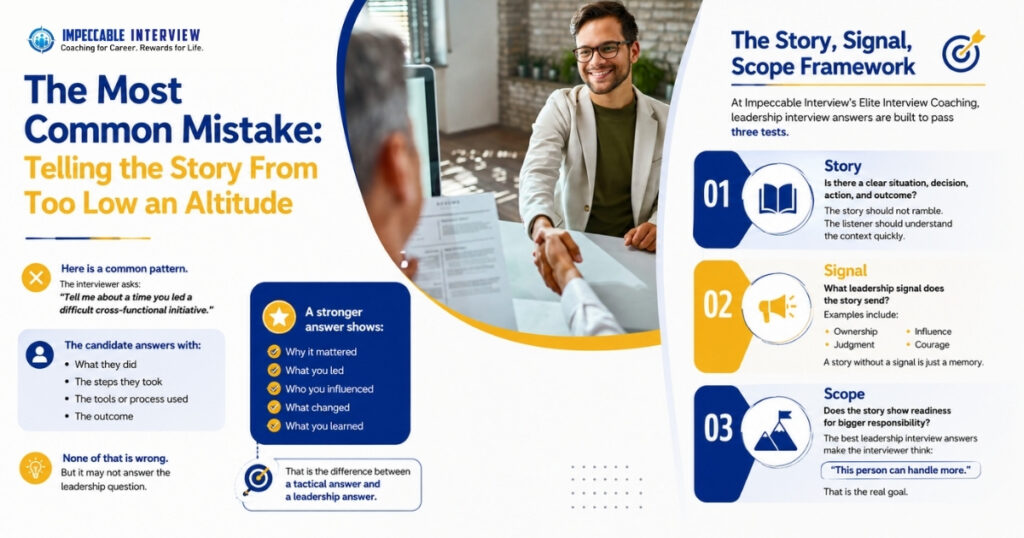
Here is a common pattern.
The interviewer asks:
“Tell me about a time you led a difficult cross-functional initiative.”
The candidate answers with:
None of that is wrong.
But it may not answer the leadership question.
A stronger answer shows:
That is the difference between a tactical answer and a leadership answer.
The Story, Signal, Scope Framework
At Impeccable Interview’s Elite Interview Coaching, leadership interview answers are built to pass three tests.
- Story
Is there a clear situation, decision, action, and outcome?
The story should not ramble.
The listener should understand the context quickly.
- Signal
What leadership signal does the story send?
Examples include:
A story without a signal is just a memory.
- Scope
Does the story show readiness for bigger responsibility?
The best leadership interview answers make the interviewer think:
“This person can handle more.”
That is the real goal.
Weak Answer vs. Stronger Leadership Answer
Interview question:
“Tell me about a time you had to influence stakeholders.”
Weak answer:
“We had a disagreement with product about the roadmap. Engineering felt the timeline was too aggressive. I met with the PM, explained the technical issues, and we eventually agreed to reduce scope.”
This answer is understandable.
But it is small.
It sounds like coordination, not leadership.
Stronger answer:
“The real issue was not just timeline. Product was trying to protect a customer commitment, while engineering was worried about quality and long-term maintainability. I reframed the conversation around business risk. We separated what had to ship for the customer from what could wait, created a phased plan, and gave leadership a clear tradeoff: speed with managed risk, instead of speed with hidden risk. That helped us protect the customer commitment without creating avoidable technical debt.”
That answer is different.
It shows:
This is what top candidates do. They do not just describe the situation. They reveal how they think.
What Top 1% Candidates Communicate Differently
The best candidates do not simply answer questions.
They create confidence.
They communicate in a way that makes interviewers believe they can be trusted in hard situations.
They do five things well.
a. They Start With the Point:
Instead of building slowly, they lead with the insight.
Example:
“The biggest leadership challenge was not the technical issue. It was aligning three groups that were optimizing for different outcomes.”
That immediately raises the altitude of the answer.
b. They Explain the Stakes:
They help the interviewer understand why the story mattered.
Example:
“If we missed the deadline, we risked losing executive confidence. If we rushed it, we risked customer-facing instability.”
Now the interviewer understands the leadership tension.
c. They Show Judgment:
They explain tradeoffs.
Example:
“I decided not to push for the perfect architecture because the business needed a staged path. But I also protected the team by documenting the follow-up investment required.”
This shows maturity.
Strong leaders understand tradeoffs.
d. They Give Measurable Outcomes:
They connect the story to results.
Example:
“We shipped the first phase on time, reduced escalation risk, and preserved the longer-term platform investment.”
Results matter.
But results must be connected to judgment.
e. They Reflect:
They show learning.
Example:
“What I learned was that cross-functional influence starts by understanding what each group is trying to protect.”
That is leadership.
Not performance theatre.
Why Smart Technology Leaders Still Need Interview Coaching
Many senior candidates have not interviewed in years.
They grew inside a company. They were promoted through reputation. They did not have to package their leadership story for an external audience.
Then suddenly, after a layoff, reorg, promotion miss, or market shift, they need to interview again.
That can trigger fear, frustration, and anger.
Some candidates start over-preparing. Others avoid preparation because they do not want to face the discomfort. Some rely too heavily on AI-generated answers. Others keep telling stories that worked five years ago but no longer match the market.
The work is not just answer practice.
It is getting clear again.
That is why Career Growth Coaching can matter as much as interview coaching. Sometimes the issue is not just the next interview. It is how the person sees their career, their value, and what is possible next.
The interview may be the presenting problem.
The deeper issue may be confidence, positioning, storytelling, belief, or conviction.
Leadership Interviews in the AI Era
AI has added another layer to leadership interviews.
Companies are not only asking whether you can manage people and projects. They are also asking whether you can lead in a changing environment.
The World Economic Forum’s Future of Jobs Report 2025 says technology skills such as AI and big data are expected to grow fast, while leadership, analytical thinking, resilience, and collaboration remain critical.
LinkedIn’s 2026 labor-market research reported that U.S. jobs requiring AI literacy skills grew 70% year over year.
For leadership candidates, this means you should be ready to answer:
You do not need to pretend you have all the answers.
But you do need to show that you are alert, curious, and responsible.
The Clarity, Confidence, Conviction Model
Strong leadership interview performance depends on three things.
Clarity
Can you explain your value in a simple way?
If your answers are too long, the interviewer may assume your thinking is unclear.
That may not be fair.
But it happens.
Confidence
Can you talk about your impact without sounding arrogant or defensive?
Many strong candidates undersell themselves. Others overcorrect and sound inflated.
Coaching helps calibrate the middle.
Conviction
Can you communicate like someone who believes they belong in the room?
This matters more than people think.
Interviewers do not only evaluate your words. They evaluate your presence.
They are asking themselves, “Would I trust this person in a hard meeting? Would I put this person in front of senior stakeholders? Would I want this person leading through ambiguity?”
That is why conviction matters.
How to Prepare for Leadership Interviews
Identify Your Five Strongest Leadership Stories
Choose stories that show:
Upgrade Each Story
For every story, add:
This is where your answer starts becoming senior.
Practice Follow-Up Pressure
Do not only practice the first answer.
Practice what happens when the interviewer asks:
A strong answer should survive follow-up pressure.
Remove Tactical Clutter
Most senior candidates need fewer details, not more.
The goal is not to tell everything.
The goal is to tell the right thing.
That is where coaching can dramatically shorten the learning curve. Instead of spending months learning through rejection, you can see the pattern earlier, sharpen the story faster, and walk into interviews with more clarity and conviction.
You can learn more about Mahesh’s background and coaching approach on the About Mahesh page, and review outcomes on the Success Stories page.
FAQ
Leadership interview coaching helps candidates prepare for interviews that test influence, judgment, executive presence, communication, and readiness for bigger scope. It is different from basic interview prep because it focuses on how the candidate thinks and leads.
It is useful for engineering managers, product leaders, senior managers, directors, and senior technology professionals preparing for higher-stakes roles. It is especially valuable if the candidate has not interviewed in years or is struggling to communicate their leadership impact.
A behavioral interview asks what you did in a past situation. A leadership interview goes deeper into judgment, influence, tradeoffs, stakeholder management, and readiness for larger responsibility.
Many strong leaders answer too tactically. They describe the project instead of showing the leadership signal. They may also struggle to communicate business impact, executive presence, or strategic judgment.
AI can help generate questions and drafts, but it cannot replace real practice, feedback, and pressure-testing. Senior candidates need answers that sound authentic, specific, and grounded in their real experience.
Ready to Show Up With More Clarity and Conviction?
If you are preparing for a high-stakes interview, Impeccable Interview can help you sharpen your story, practice difficult questions, and show up with clarity when it matters most.