A lot of smart professionals lose offers for a quiet reason.
Not experience. Not intelligence. No effort.
They talk for three minutes, and the interviewer still cannot tell what they actually did.
The work was real. The impact was real. But the story came out sideways-too much detail, no clear point, or an ending that trails off instead of landing.
That is not an experience problem. That is an interview communication problem.
Strong interview communication skills are not about sounding polished or reciting a script. They are about being understood, quickly, by someone who has heard forty answers that week and cannot remember most of them. Interview storytelling is the skill that makes yours the one they remember.
The Direct Answer: What Actually Improves Interview Communication
Improving interview communication comes down to three things: structure, signal, and delivery.
Structure means your answer has a clear shape-situation, decision, result-instead of wandering.
Signal means the story reveals something about how you think, not just what happened.
Delivery means you say it with enough clarity and conviction that the interviewer does not have to work to follow you.
Most candidates fix grammar and word choice. Almost none fix all three.
Why Good Candidates Give Confusing Answers
Here is the part nobody says out loud.
Most people are not bad communicators. They are bad communicators under pressure, in a format they rarely practice, talking about work they know so well that they forget the listener does not.
That last part matters more than people realize.
When you have lived a project for eight months, every detail feels relevant. To the interviewer, most of it is noise. They are trying to answer one question while you talk: can I trust this person with something important? Everything you say either builds that trust or buries it.
So the candidate who “knows the material” and the candidate who “communicates well” are often the same person, telling the story two different ways.
Interview Storytelling Is a Skill, Not a Personality Trait
A lot of people assume storytelling is something you either have or you do not.
That is not true, and it is not how we work with clients at Elite Interview Coaching.
Interview storytelling is closer to a craft than a gift. It has a shape you can learn, practice, and repeat under pressure. Once you see the shape, you start noticing it everywhere-in the best interview answers you have ever heard, and in the ones you have given yourself when things went well without you quite knowing why.
The shape is simple:
- Set the situation in one or two sentences, not five
- Name the decision or tradeoff you actually faced
- Show the action, briefly, without narrating every step
- Land on a result the listener can picture or measure
Most candidates over-invest in the situation and under-invest in the decision. That is exactly backward. The decision is where the interviewer learns how you think.
The Top 1% Candidate Communication Model

Strong interview answers tend to pass three tests. We call this the Top 1% Candidate Communication Model.
Structure
Does the answer have a beginning, a middle, and an end the listener can follow without asking a clarifying question? If someone has to interrupt you to figure out what actually happened, the structure has already failed, no matter how good the underlying work was.
Signal
What does this story tell the interviewer about you, specifically? A signal-free story is just an event. A story with signals shows judgment, ownership, or a way of thinking under pressure that the interviewer can picture using again in their own team.
Delivery
Pace, tone, and conviction. A great story delivered too fast, too flat, or too apologetically loses most of its power before it lands. Delivery is not performance. It is simply saying the true thing clearly enough that it gets heard.
Weak Answer vs. Stronger Answer
Interview question: “Tell me about a time you solved a difficult problem.”
Weak answer: “We had a bug in production that was causing slowdowns. I looked into the logs, found the issue in the caching layer, fixed it, and deployed the fix. The team was happy, and things went back to normal.”
Nothing here is wrong. It is just flat. There is no decision, no tension, no signal.
Stronger answer: “The tricky part was not finding the bug. It was that two teams disagreed on the cause, and a wrong guess would have meant hours of downtime during a peak sales window.
I proposed we isolate the caching layer first, since it was the cheapest hypothesis to rule out, and I was upfront with both teams that I might be wrong. It turned out to be the caching layer.
We fixed it in twenty minutes instead of losing half a day chasing the wrong lead, and afterward I wrote up the decision process so the next person wouldn’t have to relitigate it.”
Same incident. Completely different story. The second answer shows a decision, a tradeoff, and a bit of humility that makes the confidence land instead of grate.
AI-Generated Answers vs. an Authentic Human Answer
AI can help you prepare. It can help you organize a messy memory into a rough shape. But AI can also make your answers sound polished and empty. A real interview is not a script. It is a human conversation, and interviewers can tell the difference faster than most candidates expect.
An AI-polished answer often sounds like this: “I demonstrated strong problem-solving skills by collaborating cross-functionally to identify and resolve a critical production issue, resulting in improved system reliability and team efficiency.” It is grammatically clean and says almost nothing.
An authentic answer sounds like a person who was actually there: specific numbers, a real disagreement, a moment of doubt, an outcome that is concrete rather than generic. That specificity is the thing AI tends to smooth away, and it is exactly what interviewers remember.
You do not need to pretend AI does not exist. Most interviewers assume you have used it to prepare. What they are listening for is whether you can still speak like a person once the polish is stripped away.
Interview Communication in the AI Era
Communication has not become less important because of AI. If anything, it has become the differentiator.
A GMAC survey of 600 corporate recruiters found that communication ranked as the single most important skill companies are hiring for in 2026, ahead of technical AI skills, which placed 14th on the same list.
More companies are also using AI-driven assessments during the hiring process itself, with roughly 45% of mid-size and large companies now using some form of AI tool to evaluate communication and job fit before a human ever gets involved.
Put those two facts together, and the picture is clear. AI is increasingly involved in screening you, and communication is increasingly what companies are screening for. Candidates who treat storytelling as a soft, optional skill are competing at a real disadvantage against those who treat it as a trained one.
The Impeccable Interview Point of View
The interview is often the presenting problem. The deeper issue is usually confidence, positioning, or an outdated sense of how much detail a story actually needs.
We do not just help professionals find better answers. We help expand the range of answers they believe are available to them.
Most candidates we work with do not lack material. They have plenty of real accomplishments. What they lack is a trained sense of which three sentences matter and which forty do not. That is not an intelligence gap. It is a practiced skill, and like any practiced skill, it responds quickly to the right kind of feedback.
Interview Communication for Bay Area Tech Interviews
Bay Area and Silicon Valley interviews tend to move fast and involve more people than candidates expect-panel rounds, cross-functional interviewers, and back-to-back sessions where the same story might need to work for an engineering lead and a product VP within the same afternoon.
That format punishes rambling answers more than most. A story that takes four minutes to reach the point in a slower-paced interview loop can cost you the entire round in a compressed Bay Area panel format, where interviewers are comparing notes on tight timelines.
Candidates who can deliver a clean, well-structured answer in ninety seconds consistently have an easier time than those with more experience but looser storytelling habits.
How to Practice Interview Communication Skills Before Your Next Interview
- Pick five stories, not fifteen. Most candidates over-prepare breadth and under-prepare depth. Five well-built stories flex to cover most behavioral questions.
- Write the decision first. Before you write the situation, write down the actual tradeoff or judgment call. If you cannot name one, the story probably needs a different angle.
- Time yourself out loud. Ninety seconds is a good target for a first pass. If you consistently run past two minutes, the story needs to be cut, not rehearsed faster.
- Practice the follow-up question. A strong answer should survive “why did you decide that” without falling apart. If it does, the original answer was thinner than it sounded.
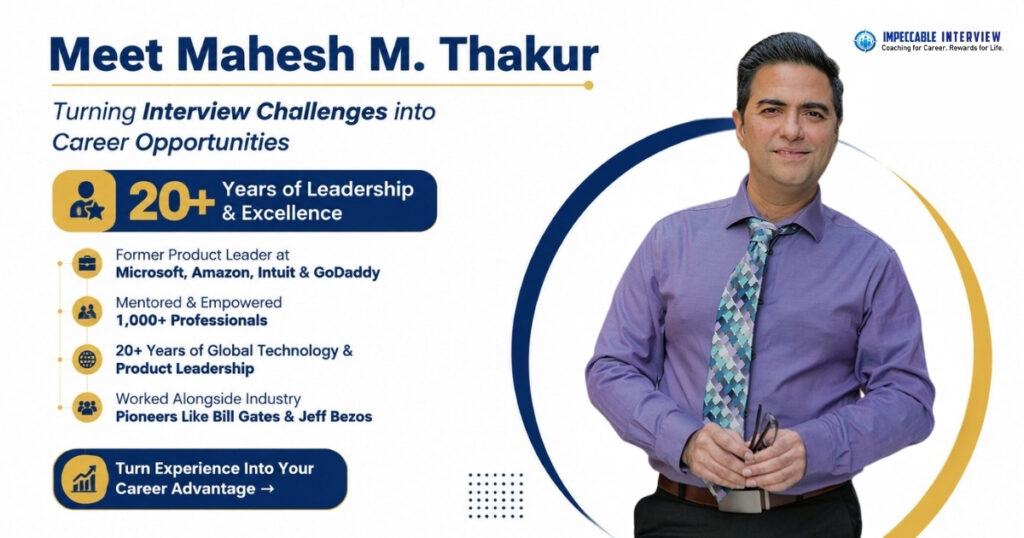
You can find more of Mahesh’s coaching approach on the About Mahesh page, and see how this plays out for real candidates on the Success Stories page.
Interview communication skills are the ability to explain your experience clearly, under pressure, in a way a listener can follow without extra effort. This includes structuring your answer, choosing what to leave out, and delivering it with enough clarity and pace that the point actually lands.
Answering the question gives facts. Interview storytelling gives facts a shape-a decision, a tension, a result-so the listener understands not just what happened but how you think. The same true events can be told as a flat report or a story that reveals judgment.
Deep experience often means too much detail feels relevant, which makes it harder to know what to cut. Many experienced professionals also have not interviewed in years and have not had to compress their work into short, structured stories for an outside audience.
AI can help you organize a rough memory into a starting structure, which is genuinely useful. It struggles to add the specific, slightly imperfect details that make an answer sound like a real person rather than a generated summary, so it should be a starting point, not a final script.
Most well-structured behavioral answers land somewhere around ninety seconds to two minutes. If you consistently run longer, that is usually a sign the story needs tighter structure rather than a faster delivery.
If you are preparing for a high-stakes interview, Impeccable Interview can help you sharpen your story, practice difficult questions, and show up with clarity when it matters most.