Fifteen years of experience, three promotions, a resume that reads well on paper. And still, the offer doesn’t come.
This is the pattern we see more than any other at Impeccable Interview. It’s not junior candidates who struggle most in the room. It’s senior ones. A director with a decade of real wins sits down for a panel round and somehow sounds less convincing than someone half their tenure. Not because the work wasn’t there. Because nobody ever taught them how to compress it.
That gap is exactly what a good interview coach exists to close.
What an Interview Coach Actually Does
A job interview coach works with you on three things a resume can’t fix: which stories to tell, how to structure them under pressure, and how to deliver them with the confidence a senior role demands. For experienced professionals, the work is less about finding material and more about cutting it down to what actually signals judgment. That’s the core of real interview coaching benefits: fewer stories, told better, landing harder.
Why Experienced Candidates Struggle More?
Ten years in, most professionals haven’t interviewed properly in a decade. They’ve been promoted from within, referred by a former manager, or hired through a network conversation that never really tested their storytelling under a panel’s clock.
So when a real interview loop finally arrives, they’re carrying more material than anyone else in the room, and less recent practice using it. That combination produces long, wandering answers that bury the one decision an interviewer actually cares about.
The Depth Problem: Too Much Experience, Too Little Signal
Here’s the part most candidates get backwards. More experience should make interviews easier. In practice, it often makes it harder.
Every year adds detail, context, and side plots to a story. An experienced professional describing a single project might have eight defensible angles to choose from. Without outside eyes, most pick the wrong one, usually the most complicated, when the interviewer just wants to know what they decided and why.
The Senior Candidate Recalibration Model
This is the framework we built specifically for professionals who have plenty of material and not enough clarity about which parts of it matter. It has four stages.
- Excavate: Pull the real decisions out of years of work, not just the outcomes. Most candidates remember what happened. Few remember why they chose one path over another, and that reasoning is the part interviewers actually want.
- Edit: Cut each story down to the two or three sentences that carry weight. Everything else, however true, is noise to a stranger hearing it once.
- Elevate: Reframe the story at the level you’re interviewing for. A senior manager candidate needs to sound like someone who already operates at director scope, not just someone hoping to.
- Execute: Rehearse the story out loud, under time pressure, with real follow-up questions. Reading it silently and saying it under pressure are two different skills entirely.
Weak Answer vs. Coached Answer
Interview question: “Tell me about a time you had to make a difficult call with limited information.”
Weak answer: “We were migrating our infrastructure and there were a lot of unknowns. I gathered as much data as I could, consulted with the team, and we made a decision. It worked out well and the migration was successful.”
Technically accurate. Completely forgettable. There’s no actual decision named, no tension, nothing an interviewer can picture.
Coached answer: “Two vendors, similar pricing, and we had eleven days before a contract renewal locked us in for another year. I couldn’t get a clean answer from either sales team, so I ran a five-day proof of concept on our actual workload instead of trusting their benchmarks. It cost us a rushed week, but it caught a latency issue that would have shown up in production eight months later. I still tell my team: trust your own test data over a vendor’s slide deck.”
Same seniority, same underlying competence. One sounds like a report. The other sounds like someone you’d trust with the next hard call.
What Professional Interview Support Actually Looks Like in Practice
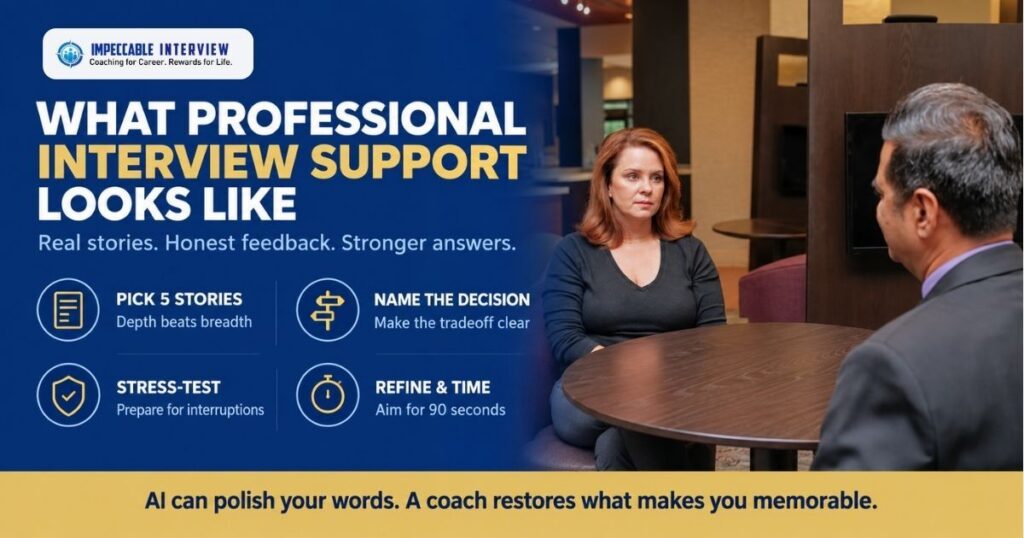
Good professional interview support isn’t a script or a set of canned answers memorized the night before. It’s closer to a rehearsal process: five or six real stories, stress-tested against follow-up questions, refined until they hold up when someone interrupts halfway through.
An interview preparation coach worth hiring will push back on your first answer, not just approve it. If your coach agrees with everything you say on the first pass, that’s usually a sign they’re not doing the job properly.
AI Can Help You Prepare. It Can Also Flatten You.
Most candidates now use AI to draft or polish their stories before an interview. That’s fine as a starting point. The risk is stopping there.
An AI-smoothed answer tends to read like this: “I leveraged cross-functional collaboration to drive a successful migration outcome while minimizing operational risk.” Grammatically clean. Says almost nothing. Interviewers hear dozens of answers like this a week and forget every one of them by lunch.
What actually lands is specific: a number, a disagreement, a moment of doubt, a result someone can picture. That texture is exactly what AI tends to sand away, and exactly what a real interview coach pushes you to put back in.
The Impeccable Interview Point of View
Most experienced professionals who come to us don’t actually need more interview practice in the generic sense. They need someone to tell them, honestly, which of their stories are strong and which ones are wasting the interviewer’s attention.
We don’t just rehearse answers. We help people see the range of stories they’re sitting on and never using, because after a decade in one company or one domain, it’s genuinely hard to judge your own material objectively. That’s the actual value of interview coaching at a senior level: an outside, honest read on what’s actually compelling.
Why This Matters More for Bay Area Senior Roles
Bay Area interview loops for senior and staff-plus roles tend to compress multiple stakeholders into a single day: an engineering lead in the morning, a product VP after lunch, a skip-level panel to close it out. The same core stories often need to flex across all three without sounding rehearsed or repetitive.
Panels comparing notes afterward tend to remember the candidate whose answers were tight and specific, not the one with the most impressive title on their resume. A senior candidate who rambles for four minutes in a tightly scheduled Bay Area loop is often eliminated before the debrief even starts.
How to Start Preparing on Your Own
- Pick five stories, not fifteen. Depth beats breadth in almost every panel round.
- Write the decision before the situation. If you can’t name the actual tradeoff, the story needs a different angle.
- Say it out loud and time it. Ninety seconds is a reasonable first target.
- Ask someone to interrupt you mid-story with “why did you decide that.” If the answer falls apart, it wasn’t ready.
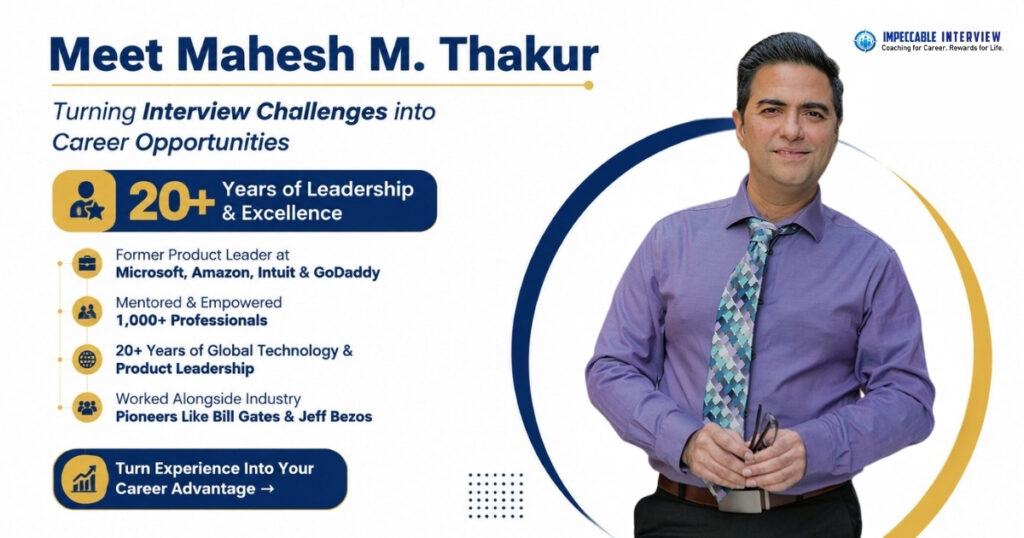
You can read more about how this plays out for real candidates on the Success Stories page, or learn more about the coaching approach on the About Mahesh page.
Frequently Asked Questions
A job interview coach helps you identify your strongest stories, structure them clearly, and deliver them with confidence under real pressure. For experienced professionals, this usually means cutting down years of material into a handful of sharp, specific answers rather than finding new content to add.
Yes. Junior candidates often need more material. Senior candidates usually have plenty and need help choosing which parts matter. The real interview coaching benefits at this level come from editing and reframing, not from generating entirely new stories from scratch.
Mock interviews test delivery. An interview preparation coach goes further, helping you choose the right stories, structure the decision clearly, and rehearse against real follow-up questions. Practice alone rarely fixes a weak story; it just makes a weak story more polished.
AI can help organize a rough memory into a starting structure, which is genuinely useful. It tends to smooth away the specific, imperfect details that make an answer sound like a real person, so it works best as a starting point for professional interview support, not a substitute for it.
Most experienced professionals see meaningful improvement within three to five sessions, enough time to rebuild five or six core stories and rehearse them under realistic follow-up pressure. Some candidates preparing for a single high-stakes loop compress this into a shorter, more intensive timeline.
If you are preparing for a high-stakes interview, Impeccable Interview can help you sharpen your story, practice difficult questions, and show up with clarity when it matters most.