Some interviews are just interviews. Others carry your next five years.
A director role you’ve worked toward for a decade. The first real offer after a layoff. A final loop at a company you’ve admired for years. A move into a bigger scope than you’ve ever managed before. When the stakes are that high, most candidates just do more of what they always do.
They reread the job description one more time. They skim a few more blog posts about common questions. They tell themselves that if they just know enough, the rest will take care of itself. That’s not high-stakes interview preparation. That’s anxiety with a to-do list, and it rarely holds up once the questions get harder and the room gets quieter.
The candidates who walk out of a high-stakes interview with an offer aren’t always the most qualified people in the pipeline. They’re usually the ones who prepared differently. They treated the process as a performance under pressure, not a test of memory. That distinction is small to describe and enormous to feel, and it’s the difference this page is going to walk through.
What High-Stakes Interview Preparation Actually Means
High-stakes interview preparation is the work of getting ready to perform under pressure, not just to answer questions. It means knowing what the panel is really deciding, choosing the few stories that prove you can do the job, rehearsing them out loud under realistic pressure, and walking in with a clear point of view on why you’re the right hire. Knowledge gets you into the room. Readiness gets you the offer.
Most preparation stops at knowledge. Candidates study the company, study the product, study the interviewers on LinkedIn, and assume that’s enough. It isn’t, because knowledge doesn’t tell your nervous system what to do when a panelist interrupts you mid-story, or when you’re asked the one question you hoped wouldn’t come up. That’s where a proper interview preparation strategy earns its name. It’s not a checklist you complete once. It’s a sequence of work, done in the right order, that changes how you perform when it counts.
This is what separates a senior professional interview from an entry-level one. At the senior level, the panel already assumes you can do the technical or functional parts of the job. What they’re actually testing is judgment, composure, and whether you can represent that judgment clearly under time pressure. Preparing for that requires a different kind of work than reading FAQs.
Why Strong Candidates Struggle in a High-Stakes Interview
Here’s what I see again and again. The candidate is qualified. Sometimes overqualified. On paper, there’s no reason this interview should go badly. But the moment the stakes rise, their answers change, and not for the better.
They over-explain. Fear makes people tell everything, just in case. A question that needs thirty seconds gets three minutes, because the candidate is terrified of leaving something out. The interviewer loses the thread somewhere in the middle, and the strongest part of the answer gets buried under details nobody asked for.
They drop altitude. A senior candidate starts describing tickets and tools instead of decisions and outcomes. Instead of explaining why they chose one approach over another and what it cost the business when it went wrong, they describe the mechanics of the work, the way a junior employee would. The panel is left to guess at the judgment behind the actions, and guessing rarely favors the candidate.
They play defense. Every answer sounds like it’s guarding against a mistake instead of making a case. Instead of showing conviction about what they’d do differently, or why they’re the right person for the specific problems this role needs solved, they hedge. They qualify. They protect themselves from being wrong instead of committing to being right.
None of this is a skills problem. These are people who can do the job, often better than most of the field. It’s a pressure problem, and pressure changes behavior in specific, predictable ways. The good news is that pressure is something you can prepare for, the same way an athlete prepares for game conditions instead of just practicing drills in an empty gym.
The High-Stakes Readiness Ladder
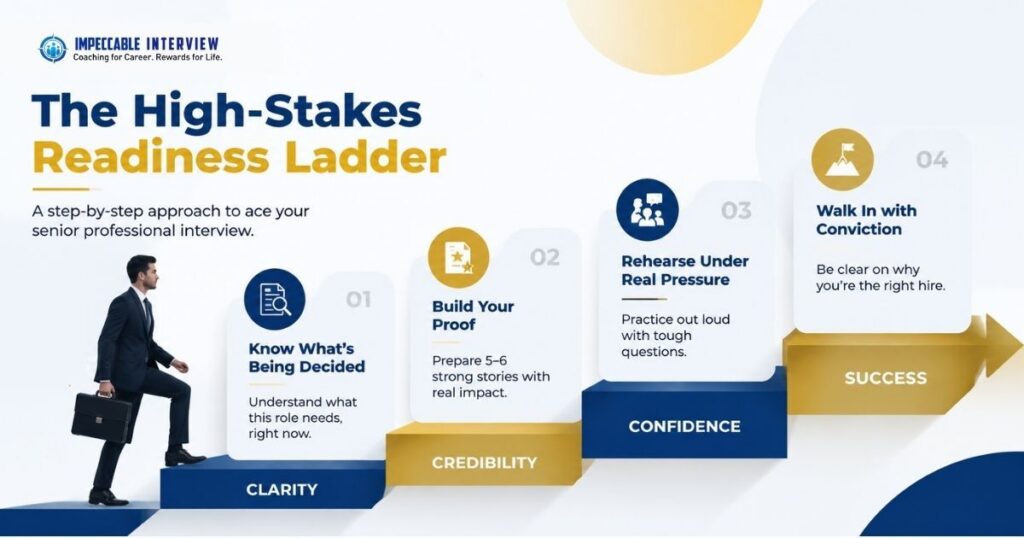
This is the model we use with clients preparing for the interviews that matter most. Four rungs. Each one builds on the last, and skipping a rung is exactly where most preparation quietly breaks down.
- Know what’s being decided: Every senior professional interview comes down to one question. Can this person operate at this level, here, now? Find out what “this level” means for this role, specifically. That means reading the job description as a signal of what the business is worried about, talking to people who’ve interviewed there if you can, and being honest with yourself about the gap between where you are and where this role needs you to be.
- Build your proof: Pick five or six stories that prove you can do that job. Each needs a clear problem, your specific judgment, and a result someone will remember. Not eight stories, not two. Five or six gives you enough range to answer almost anything the panel throws at you, without spreading yourself so thin that none of the stories land with real detail.
- Rehearse under real pressure: Reading answers in your head isn’t rehearsal. Say them out loud. Get interrupted. Have someone ask a hostile follow-up before you’ve finished your sentence. Pressure in practice makes pressure on the day feel familiar, and familiarity is what keeps your voice steady when the actual panel pushes back.
- Walk in with conviction: Before you enter the room, decide why you’re the right hire. One sentence. If you don’t believe it, the panel won’t either. This isn’t a marketing line you memorize. It’s the honest answer to why this specific role, at this specific company, fits what you’re uniquely good at.
Most people spend almost all their time on rung two, building the proof. Rung three, rehearsing under real pressure, is where offers are won, and it’s the rung almost everyone skips.
Weak vs. Strong: What the Difference Sounds Like
“Why are you the right person for this role?”
Weak answer: “I have 15 years of experience in software, I’ve led teams, I’m passionate about the product, and I think I’d be a great fit.”
Stronger answer: “You need someone who can take a platform team through a messy migration without stalling the roadmap. I’ve done that twice. The last time, we moved our core services over three quarters and still shipped every major release on schedule. That’s the problem I’m best at, and it looks like your biggest one right now.”
The first answer lists. It’s a summary of a resume that the panel has already read. The second diagnoses and connects. It shows the candidate has thought about what the company actually needs, not just what they personally want to say about themselves. That’s the difference between a candidate and a hire, and it’s a difference that comes entirely from preparation, not talent.
AI-Polished vs. Human: “Tell me about a failure.”
AI can help you prepare. But AI can also make your answers sound polished and empty, and experienced interviewers can hear the difference within a sentence or two.
AI-polished answer: “I believe failure is an opportunity for growth. In one instance, a project did not meet expectations, and I learned the importance of communication and stakeholder alignment.”
Human answer: “I pushed a launch date my team told me was too aggressive. We hit it, then spent six weeks fixing what we rushed. Now I ask one question before committing to any date: what are we choosing not to test?”
Real decision, real cost, real change. That’s what interviewers remember. A real interview isn’t a script, and the more an answer sounds like it could belong to anyone, the less it does its job. It’s a human conversation, and the candidates who prepare for it as one are the ones who stand out.
Your Interview Preparation Strategy for the Final Week
Days 7 to 5: Read the job description as a list of problems, not requirements. Every line is a hint about what keeps this hiring manager up at night. Translate each requirement into the underlying problem it’s trying to solve, because that’s the language your answers need to speak.
Days 4 to 3: Lock your stories. Match each one to a problem the role needs solved. Don’t keep adding new material at this stage. The goal is depth on a small set of stories, not breadth across everything you’ve ever done.
Days 2 to 1: Run at least one full mock interview with someone who’ll push back. Not a friend who’ll tell you it sounded great. Someone who will interrupt, challenge, and ask the follow-up question you’re hoping to avoid. Then stop adding material. More prep at this point usually adds noise, not readiness.
Interview day: Review your one-sentence case. Protect your energy. Walk in to have a conversation, not to survive an exam. If AI touches the role, and in tech it usually does, be ready to talk about how you use it and where your judgment still matters. You don’t need to pretend to be an AI expert. You do need to show curiosity, adaptability, and future readiness. The World Economic Forum’s Future of Jobs research consistently points to exactly these traits as what employers are prioritizing now, which makes them worth naming directly if the conversation opens the door.
The Impeccable Interview Point of View
The interview is often the presenting problem. The deeper issue may be confidence, positioning, storytelling, AI-era readiness, or an outdated view of what’s possible next. After a layoff or a run of near-misses, people start interviewing to avoid rejection instead of to win. You can hear it in their answers. The energy shifts from “here’s what I bring” to “please don’t find a reason to say no,” and panels notice that shift even when they can’t quite name it.
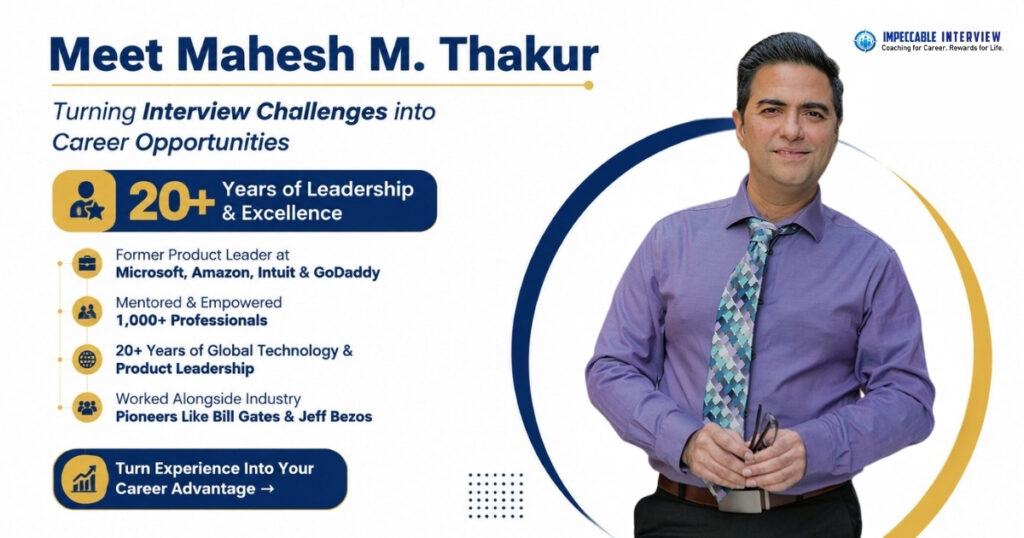
That’s why our Elite Interview Coaching works on both sides: the stories and the belief behind them. Mahesh spent years as a product executive and hiring manager at Microsoft and Amazon, so preparation starts from what the other side of the table is actually deciding, not just from generic interview advice. One senior engineering manager at Google credits sharper storytelling and influencing with earning a strong hire from the Director on his panel. You can read more on our Success Stories page.
We don’t just help professionals find better answers. We help expand the range of answers they believe are available to them. Shorten the learning curve. Avoid months of trial-and-error. Walk into the next opportunity with clarity, confidence, and conviction.
Why This Matters for Bay Area Tech Candidates
In Silicon Valley, the high-stakes moment is rarely one conversation. It’s a full loop: recruiter screen, hiring manager, a panel, and a leadership round, sometimes stretched across weeks. Every interviewer compares notes afterward, and inconsistency across rounds reads as a warning sign even when each individual round went reasonably well.
A candidate who’s sharp in round one and scattered by round four rarely gets the offer, no matter how strong their background looks on paper. Preparing for pressure is what holds your story together across every round, so the version of you the leadership panel meets is just as clear and convincing as the version the recruiter met three weeks earlier.
If you are preparing for a high-stakes interview, Impeccable Interview can help you sharpen your story, practice difficult questions, and show up with clarity when it matters most.
Frequently Asked Questions
For a senior role, two to three weeks of focused preparation is usually enough. The time goes into choosing the right stories and rehearsing them under pressure, not memorizing answers. With only a few days’ notice, prioritize your one-sentence case, your top stories and one full mock interview.
Answering at the wrong altitude. Senior candidates often describe the work in detail instead of the decisions, trade-offs and outcomes they owned. Interviewers are judging whether you can operate at the next level, so your answers need to sound like that level.
Yes, for research, practice questions and rough first drafts. Don’t memorize AI-written answers. They tend to sound generic, and interviewers notice. Use AI to prepare, then make every story sound like you.
Calm comes from familiarity, not willpower. If you’ve already answered hard follow-ups out loud with someone pushing back, the real interview feels like the fifth time, not the first. A clear one-sentence case for why you’re the right hire also gives you something steady to return to.
When the role is a clear step up, when you’re returning to the market after a layoff, or when you keep reaching final rounds without offers. A coach with hiring-manager experience can spot what you can’t see in your own answers. That shortens the learning curve and saves months of trial-and-error.