A lot of smart technology professionals are worried right now.
They have strong experience. They have worked at good companies. They have shipped products, written code, managed teams, built platforms, or delivered results.
But when AI comes up in an interview, something happens.
They hesitate.
They do not want to exaggerate. They do not want to sound behind. They do not want to give some generic ChatGPT answer. And they definitely do not want the interviewer thinking, “This person was good in the old world, but I am not sure they are ready for the next one.”
That is why AI interview preparation now matters.
AI interview preparation is not about memorizing AI buzzwords. It is about showing curiosity, judgment, adaptability, and the ability to connect AI to real work. The strongest candidates do not just say they use AI. They explain how AI changes the way they learn, build, decide, communicate, and create value.
AI Has Changed What Interviewers Listen For
AI has changed the interview because it has changed the expectations.
The World Economic Forum’s Future of Jobs Report 2025 says AI, big data, networks, cybersecurity, and technology skills are among the fastest-growing skill areas. It also says human skills like analytical thinking, resilience, leadership, and collaboration remain critical.
LinkedIn’s 2026 labor-market research reported that U.S. jobs requiring AI literacy skills grew 70% year over year.
That means AI is not just for AI engineers anymore.
If you are a software engineer, product manager, engineering manager, senior manager, director, or senior technology professional, you need to be able to talk about AI intelligently.
Not perfectly.
Intelligently.
You may be asked:
- How are you using AI in your work?
- How is AI changing your role?
- What AI tools have you used?
- What would you not delegate to AI?
- How would you introduce AI into your team?
- How do you evaluate whether an AI use case is actually valuable?
The wrong answer is not always, “I do not know.”
Sometimes the wrong answer is a shallow answer that proves you have not really thought about it.
The Mistake: Sounding AI-Aware but Not AI-Ready
A lot of candidates now say some version of this:
“I use ChatGPT to be more productive.”
That may be true.
But it is not enough.
It does not show judgment. It does not show leadership. It does not show how you use AI in the context of customers, architecture, product decisions, engineering quality, business outcomes, or team productivity.
A stronger answer sounds like this:
“I use AI as a thinking partner, not as a replacement for judgment. For example, I use it to pressure-test requirements, summarize technical tradeoffs, draft first-pass communication, and identify blind spots in planning. But I still validate the output, check assumptions, and make the final decision based on customer impact, engineering constraints, and business priorities.”
That answer is different.
It says:
• You understand how to use AI practically.
• You understand its limitations.
• You apply human judgment.
• You connect AI to business and customer outcomes.
• You remain accountable for the final decision.
That is what companies want to hear.
The AI-Ready Candidate Framework
At Impeccable Interview’s Elite Interview Coaching, the goal is not to help clients memorize better answers. The goal is to help them think better, communicate better, and show up with conviction when the stakes are high.
For AI-era interviews, candidates need to prepare across five areas.
1. Awareness
Can you explain how AI is changing your function?
A product manager should understand how AI affects discovery, experimentation, customer support, analytics, personalization, and feature prioritization.
A software engineer should understand how AI affects development speed, code review, debugging, testing, documentation, and architecture discussions.
An engineering manager should understand how AI changes team productivity, quality control, skill development, and decision-making.
You do not need to be the world expert.
But you cannot look asleep.
2. Application
Can you give a real example of how you use AI?
Weak answer:
“I use AI to write faster.”
Stronger answer:
“I used AI to summarize customer feedback into themes, then validated those themes against support tickets and product analytics. It helped me move faster, but the decision still came from triangulating the AI summary with actual customer and usage data.”
That is the difference.
One answer says you used a tool.
The other answer says you used judgment.
3. Judgment
Can you explain what you would not delegate to AI?
This is where senior candidates stand out.
A strong candidate can say:
“I do not outsource accountability to AI. I may use AI to generate options, but I do not let it make decisions about customer tradeoffs, security risk, people decisions, or strategic priorities without human review.”
That answer shows maturity.
It also shows that you understand the difference between speed and responsibility.
4. Adaptability
Can you show that you are learning?
Hiring teams do not expect everyone to be an AI expert.
But they do expect serious professionals to be curious.
A candidate who says, “I have not had time to learn AI,” creates concern.
A stronger answer is:
“I am still building depth, but I have created a weekly learning rhythm. I am testing AI tools in my workflow, studying how other teams are using them, and looking for practical use cases where the output can be measured.”
That is honest. It is also active.
5. Leadership
Can you help others become AI-ready?
This matters even more for managers, senior managers, directors, and product or engineering leaders.
A leadership-level answer might sound like this:
“I would not start by forcing tools on the team. I would start by identifying repetitive work, decision bottlenecks, and areas where AI could improve quality or speed. Then I would create responsible-use guidelines, share examples, and measure whether AI actually improves outcomes.”
That sounds like a leader.
Not just a user.
AI-Generated Answers Are Not Enough
AI can help you prepare.
But AI can also make your answers sound polished and empty.
A real interview is not a script. It is a human conversation.
The interviewer can interrupt you. They can challenge your assumptions. They can ask for numbers. They can ask what you personally did. They can ask what failed. They can test whether you understand the answer or merely memorized it.
That is why interview coaching still matters in the AI era.
AI can help you draft.
But you still need to become clear, credible, and adaptive under pressure.
The Deeper Problem Is Often Not AI:
Many candidates think they have an AI problem.
Often, they have a confidence problem.
Or a positioning problem.
Or a fear problem.
They are not sure how to connect their past experience to the future. They feel behind. They are frustrated that what made them successful five years ago may not be enough now. Some are angry about layoffs. Some feel boxed in. Some have stopped seeing possibilities.
That is the real work.
The interview may be the presenting problem. The deeper issue may be fear, frustration, outdated assumptions, or loss of belief.
This is where Career Growth Coaching becomes powerful. The work is not just “how do I answer this interview question?” It is also “how do I see my career, my value, and my future differently?”
The best coaching shortens the learning curve.
Instead of spending months guessing what hiring teams want, you learn how to think, communicate, and show up with clarity.
Instead of carrying worry into every conversation, you start building conviction.
Weak AI Answer vs. Strong AI-Ready Answer
Interview question:
“How are you using AI in your work?”
Weak answer:
“I use ChatGPT for writing emails, brainstorming, and summarizing things. It saves time.”
Strong AI-ready answer:
“I use AI in three ways: speed, quality, and perspective. For speed, I use it to summarize long documents or draft first-pass communication. For quality, I use it to check whether I have missed edge cases or stakeholder concerns. For perspective, I ask it to challenge my assumptions before I present a recommendation. But I treat the output as input, not truth. I still validate the details and make the final judgment.”
That answer is more powerful because it shows:
• Practical AI experience
• Critical thinking
• A structured approach
• Validation
• Accountability
• Business awareness
That is what strong candidates do.
How to Prepare for AI Interview Questions
Start here.
Build Your AI Inventory
List where you have used AI personally or professionally.
Include:
- AI tools you have used
- Problems you used them to solve
- Tasks where AI improved your speed
- Tasks where AI improved quality or insight
- Examples where AI supported decision-making
- Situations where you chose not to rely on AI
Pick Three Real Examples
Choose examples where AI helped you improve speed, quality, insight, or decision-making.
Do not pick examples just because they sound impressive.
Pick examples you can defend.
Add Judgment
For each example, explain what you checked, validated, or decided yourself.
This is where many candidates fail.
They talk about the tool. They forget to talk about the thinking.
Connect to Business Value
Do not stop at “I used AI.”
Explain what changed:
- Did the work become faster?
- Did quality improve?
- Did you identify an issue earlier?
- Did you make a better-informed decision?
- Did the team reduce repetitive work?
- Did the customer experience improve?
Practice Follow-Up Questions
Expect the interviewer to ask:
- Why did you choose that AI tool?
- How did you validate the output?
- What went wrong?
- What would you do differently?
- What risks did you identify?
- What part did you personally own?
- How did you measure the result?
What would you not use AI for?
This is where memorized answers break.
This is where real preparation shows.
Why Impeccable Interview Is Different
At Impeccable Interview, the goal is not to produce robotic interview answers.
The goal is to help you become interview-ready, AI-ready, and conviction-ready.
That means you learn how to:
- Communicate your experience with clarity
- Connect your experience to future expectations
- Demonstrate judgment instead of simply naming AI tools
- Answer difficult questions without sounding rehearsed
- Handle follow-up pressure
- Show confidence without exaggeration
- Communicate your value with conviction
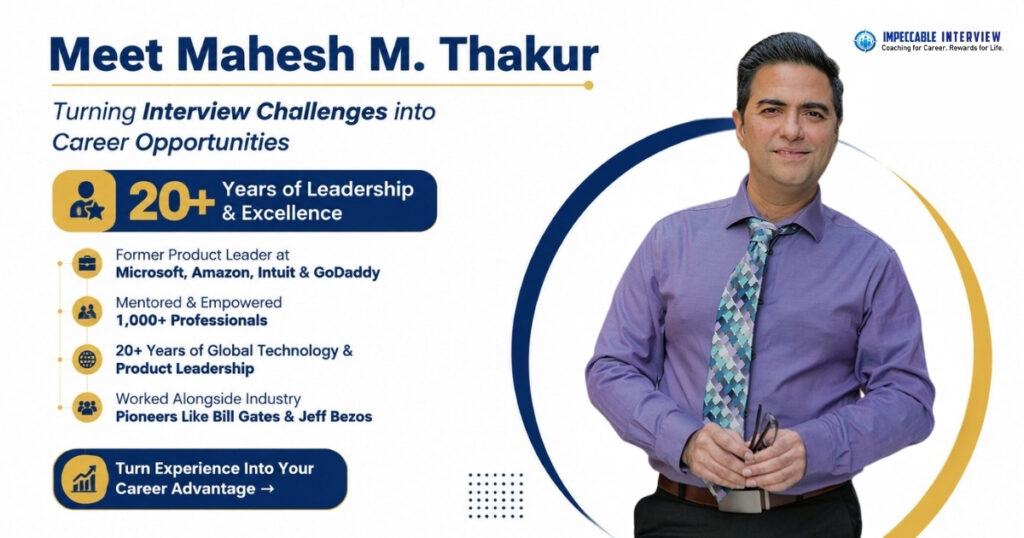
Mahesh brings CEO-grade coaching tools and real technology leadership experience into the process. You are not getting generic interview tips. You are learning how strong leaders think, prepare, and communicate.
You can also review client success stories to see how this work has helped professionals move from uncertainty to clarity and action.
FAQ
No. But you do need to show that you are learning, adapting, and thinking clearly about how AI affects your work. For many technology roles, basic AI literacy is becoming part of professional credibility.
Be honest, but do not sound passive. Talk about how you are learning, where you see practical use cases, and how you would evaluate AI responsibly in your role.
You can, but do not make ChatGPT the whole answer. Talk about the workflow, judgment, validation, and business outcome. The tool matters less than how you think.
Use a real example. Explain the context, what you used AI for, what you checked yourself, and what improved. Generic claims sound weak. Specific examples build trust.
Yes. The right coaching can help you connect your experience to future expectations, practice AI-related questions, and communicate with more confidence and judgment.
If you are feeling stuck, behind, or uncertain about how to compete in the AI era, Impeccable Interview can help you shorten the learning curve, strengthen your positioning, and move forward with belief and conviction.